

Aluminum Cap Color Coding For Pharmaceutical Vials: Complete Guide
Leave a message

- pharmaceutical packaging
- safety guidelines
- color coding
- best practices
Quick Summary: There is no universal standard for aluminum cap colors in pharmaceutical packaging. However, color coding is a powerful tool for preventing medication errors, differentiating drug strengths, and improving inventory management. This guide covers industry best practices, common color conventions, implementation strategies, and how to choose the right aluminum flip-off caps for your color coding system.
Why Color Code Pharmaceutical Vials?
Walk into any compounding pharmacy or peptide manufacturing facility and you'll see shelves lined with vials sporting caps in blue, red, green, yellow-a rainbow of pharmaceutical packaging. This isn't just aesthetics. Color coding aluminum caps serves critical safety and operational functions:
1. Preventing Medication Errors
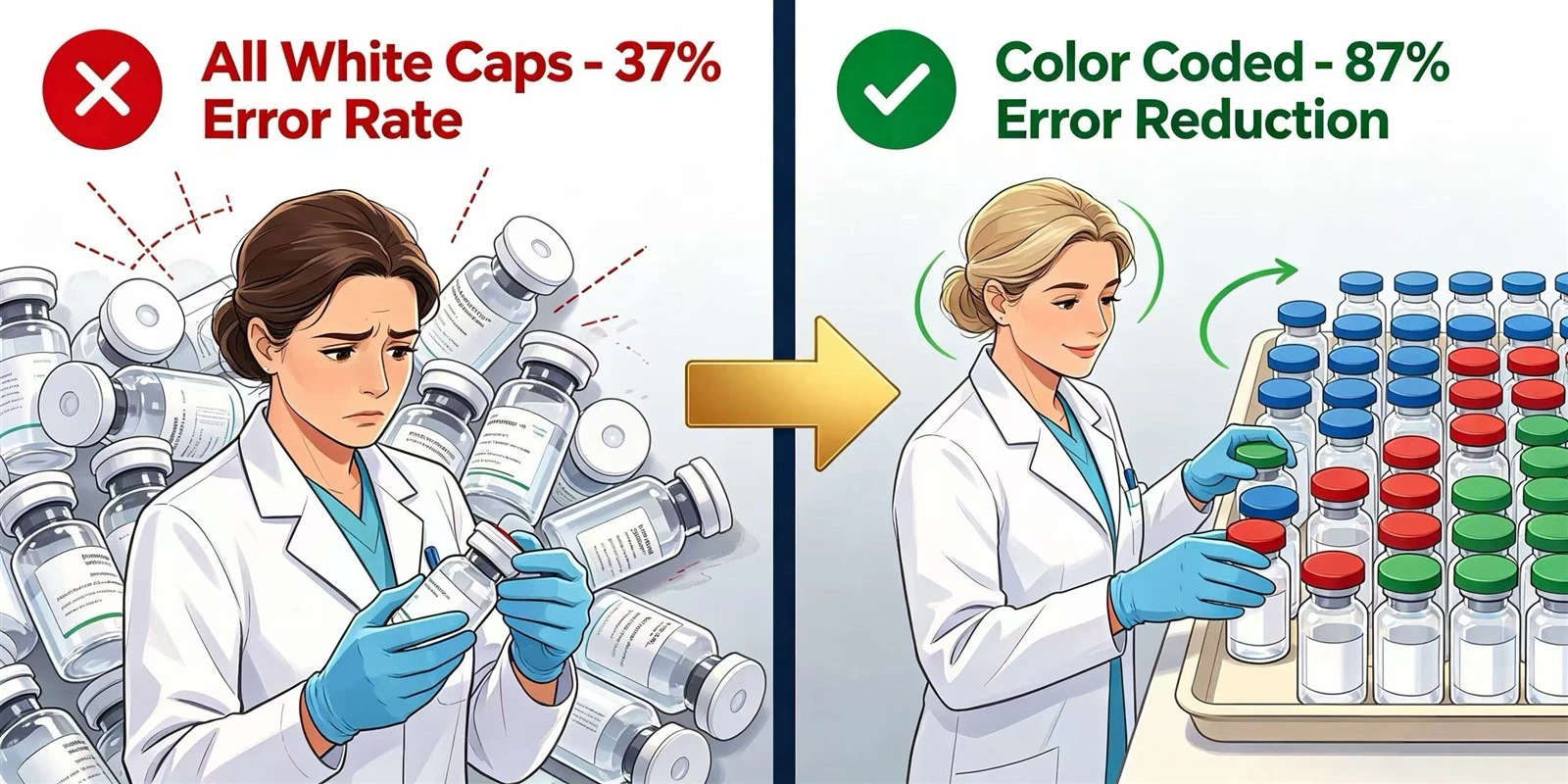
A 2023 ISMP (Institute for Safe Medication Practices) study found that 37% of medication errors in compounding pharmacies involved look-alike vials. When multiple strengths of the same peptide or drug look identical, mix-ups happen. Color coding provides an immediate visual cue that catches errors before they reach the patient.
📊 Real-World Impact: Peptide Pharmacy Case Study
A compounding pharmacy dispensing BPC-157 in 5mg, 10mg, and 15mg doses implemented a color coding system:
Before color coding: 8 near-miss errors per month (wrong strength selected for order)
After implementing blue (5mg), red (10mg), green (15mg): 1 near-miss error per month
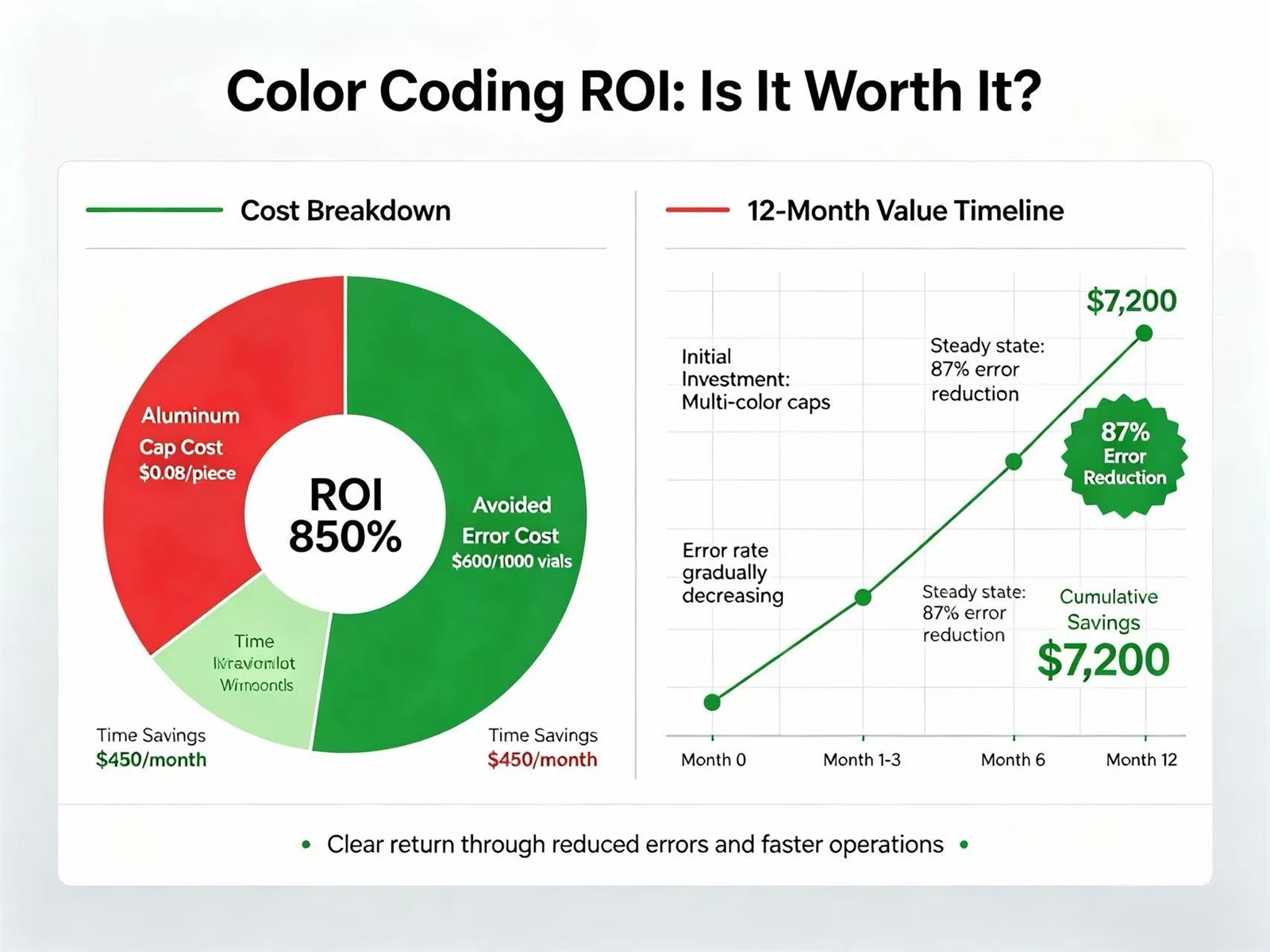
Result: 87.5% reduction in strength-selection errors
Source: Internal audit data from 150-prescription/month compounding pharmacy, January-June 2026
2. Faster Inventory Management
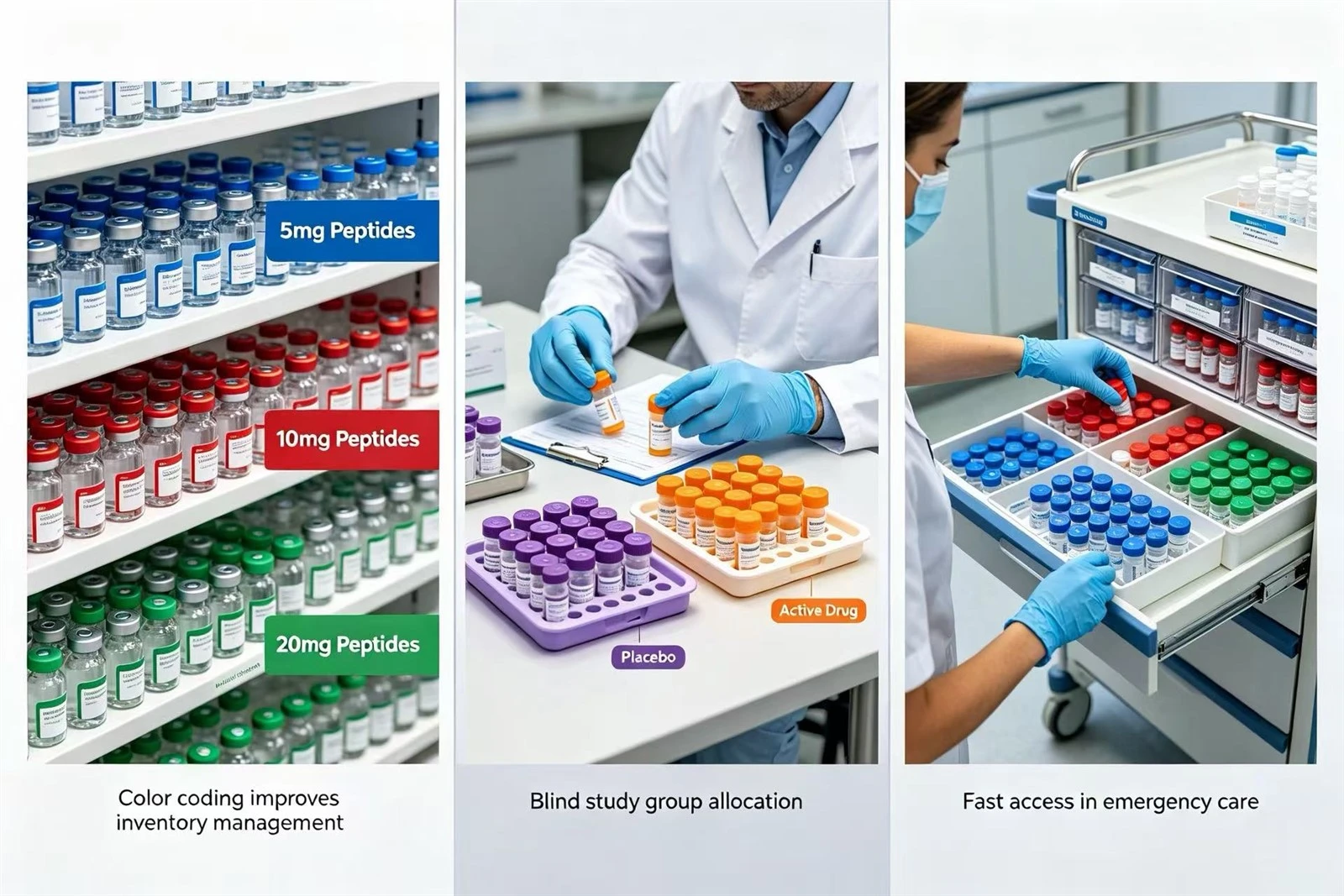
Color coding speeds up stock checks and order fulfillment. Staff can visually scan shelves to identify low-stock items without reading every label. For facilities handling 50+ vial types, this saves hours per week.
3. Clinical Trial Blinding
In double-blind clinical trials, color coding helps maintain blinding while allowing pharmacy staff to correctly dispense active drug vs placebo. For example, purple caps for placebo and orange caps for active treatment-both groups get labeled vials, but the colors help ensure correct distribution without revealing treatment assignment to clinicians.
4. Temperature and Storage Differentiation
Some facilities use color to indicate storage requirements: yellow for room temperature, blue for refrigerated (2-8°C), green for frozen (-20°C). This prevents temperature excursions that could compromise product stability.
Common Industry Color Conventions
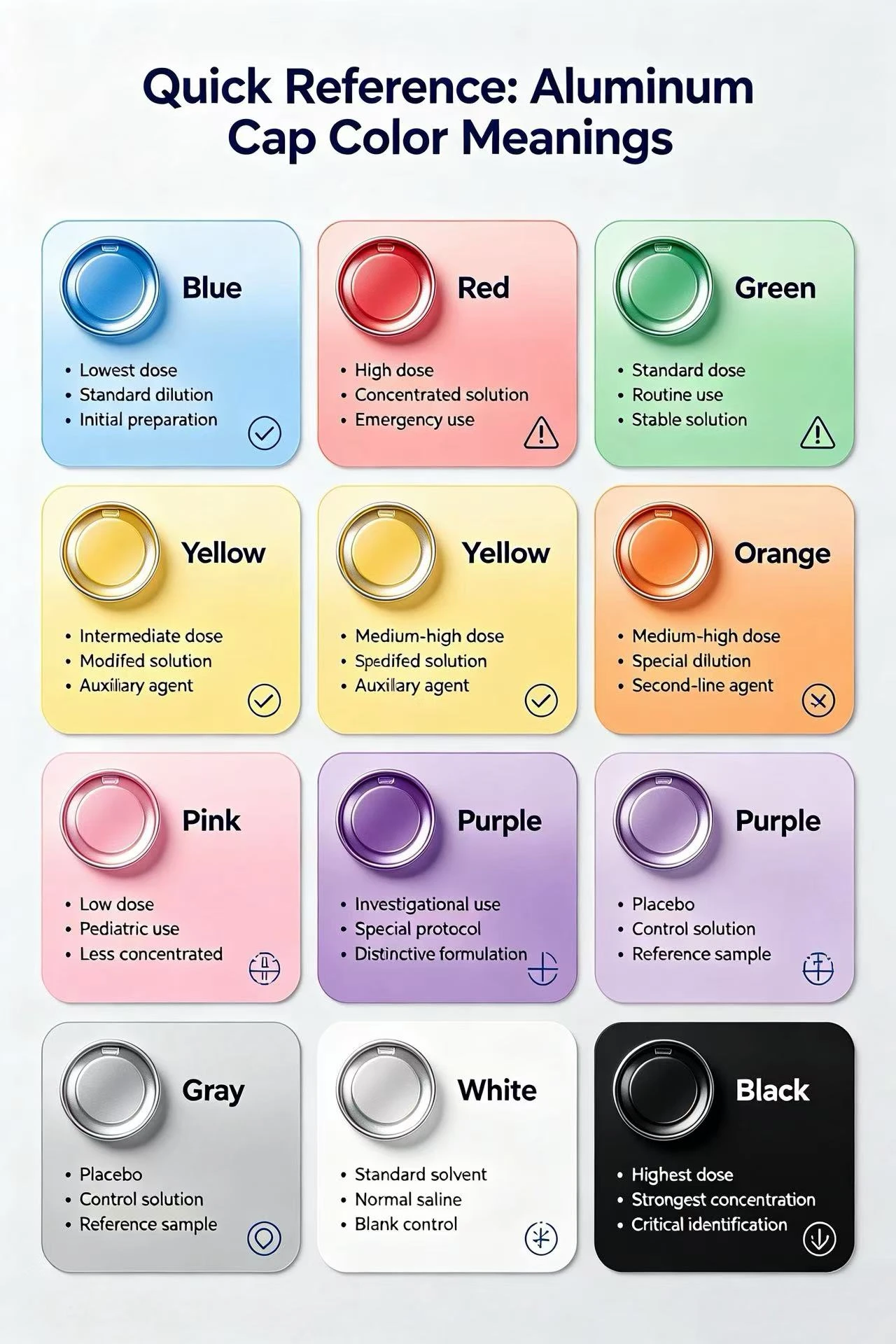
While no regulatory body mandates specific colors, informal industry patterns have emerged:
| Color | Common Uses | Industry Convention |
|---|---|---|
| Blue | Lowest strength, standard formulations, general use | Most widely used color. Often represents "baseline" or lowest dose in a strength series. |
| Red | Medium strength, "caution" items, high-alert medications | Red signals attention. Used for mid-range strengths or products requiring extra verification. |
| Green | Highest strength, "go" for ready-to-use formulations | Often indicates highest dose in a series or products cleared for immediate use. |
| Yellow | Reconstitution solutions, diluents, bacteriostatic water | Frequently used for non-drug supplies (saline, BAC water) to distinguish from active pharmaceutical ingredients. |
| Orange | Veterinary use, non-human formulations | Clearly differentiates animal health products from human pharmaceuticals. |
| Pink | Female hormone therapies, specialty formulations | Sometimes used for estrogen, progesterone, or other hormone preparations marketed to women. |
| Purple | Clinical trial placebo, specialty peptides | Less common in routine use, making it ideal for distinguishing trial materials or unique formulations. |
| Gray | Expired stock, quality control holds, quarantine | Signals "do not use" or "pending approval." Helps prevent accidental dispensing of problem stock. |
| White | Generic/unspecified, single-product lines | Neutral option when no specific coding is needed. Common for facilities with few product types. |
| Black | Controlled substances, high-security items | Rare in routine use. Sometimes indicates Schedule II-III narcotics requiring extra documentation. |
⚠️ Important Reminder:
These are industry conventions, not regulations. Your organization can define any color system that makes sense for your operations. The key is consistency and documentation.
How to Create an Effective Color Coding System
Step 1: Identify Your Coding Needs
What are you trying to differentiate? Common scenarios:
Drug Strength: 5mg (blue), 10mg (red), 20mg (green)
Product Type: Peptides (blue), steroids (red), vitamins (yellow)
Storage Conditions: Room temp (yellow), refrigerated (blue), frozen (green)
Clinical Trial Phases: Phase I (purple), Phase II (orange), Phase III (green)
Customer Segments: Retail (blue), wholesale (red), export (green)
Most facilities use a hybrid approach: primary coding for drug strength within a product line, with secondary indicators for special handling.
Step 2: Choose Visually Distinct Colors
✅ Best Practices for Color Selection:
High contrast: Avoid pairing similar colors (e.g., red + pink, blue + purple)
Colorblind-friendly: ~8% of men have red-green colorblindness. Pair red/green with secondary indicators (labels, symbols)
Limit your palette: Use 3-5 core colors. More than 7-8 colors becomes confusing
Consider lighting: Colors look different under fluorescent vs LED vs natural light. Test your system in your actual work environment
Step 3: Document Your System in SOPs
Your color coding system must be documented in Standard Operating Procedures. Include:
1. Color assignment table: What each color means, with examples
2. Visual reference guide: Post charts showing actual cap samples in work areas
3. Training requirements: All staff must demonstrate understanding before handling vials
4. Exception procedures: What to do when a color runs out or a new product doesn't fit the existing system
5. Audit procedures: Regular checks to ensure colors are being used correctly
🚨 Critical Safety Rule:
Never rely on color alone. Color coding is a secondary safety check, not the primary identification method. Every vial must have a clear
label with:
Drug name (generic and brand if applicable)
Strength and volume
Lot number
Expiration date
Storage requirements
Train staff that checking the label is mandatory before every withdrawal or administration, regardless of cap color.
Step 4: Order Appropriate Quantities
Stock colors based on usage patterns. Example for a peptide pharmacy dispensing 1,000 vials/month:
Blue (5mg, 60% of orders): Order 3,000 caps to maintain 3-month inventory
Red (10mg, 30% of orders): Order 1,500 caps
Green (20mg, 10% of orders): Order 500 caps
Yellow (BAC water): Order 1,000 caps (1:1 ratio with vials)
Most suppliers offer aluminum flip-off caps with MOQ 1,000 pieces per color and 5-7 day lead time for stock colors.
Step 5: Validate and Audit
Implement ongoing monitoring:
Monthly audits: Random sample 20 vials and verify color matches label
Near-miss tracking: Log every instance where someone "almost" grabbed the wrong vial, caught by color check
Staff feedback: Survey team quarterly-are colors helping or causing confusion?
Revise as needed: If a color isn't working, change it. Document the change and retrain staff.
Common Mistakes to Avoid
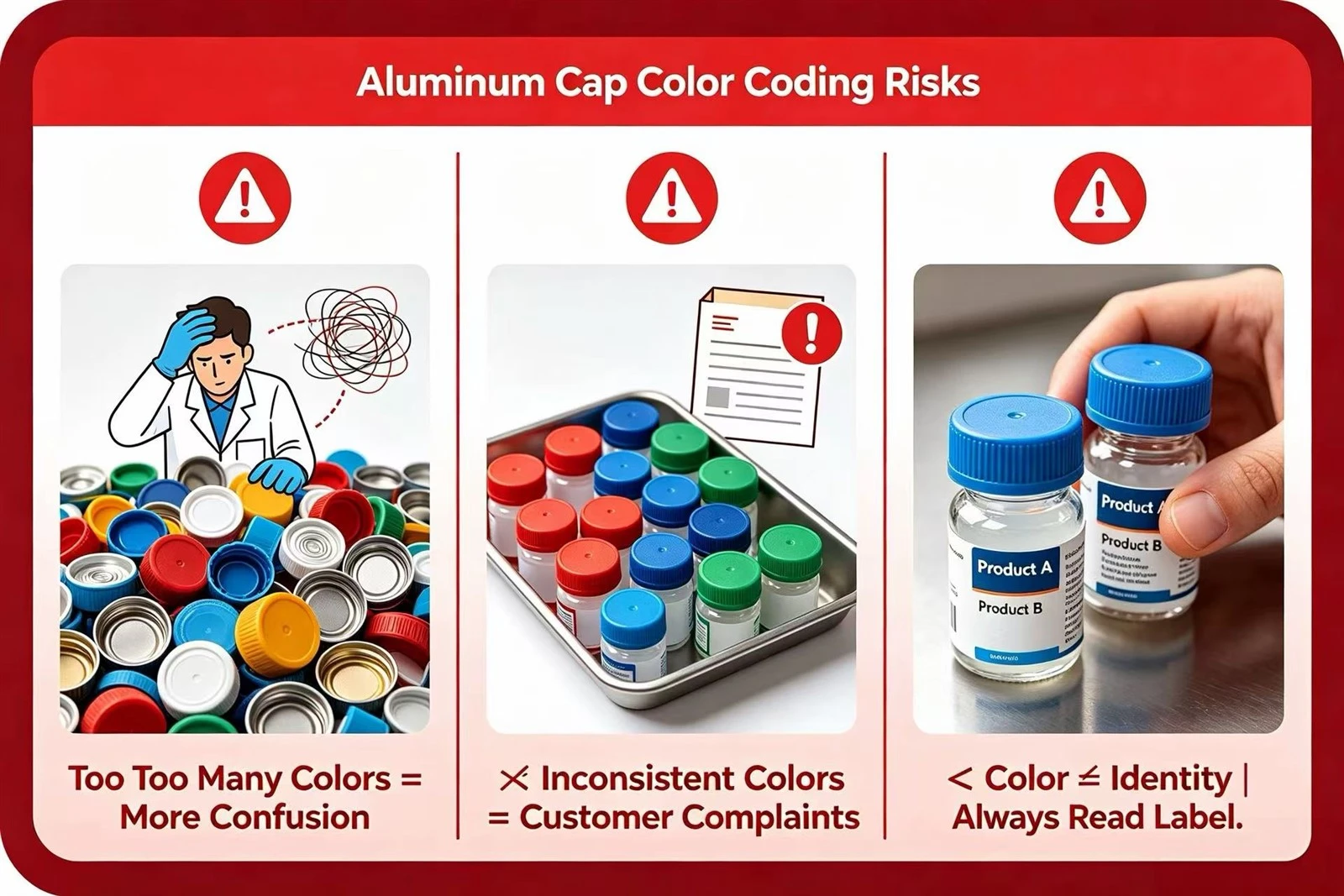
Mistake #1: Using Too Many Colors
One facility tried to assign a unique color to every single product-28 different colors. Staff couldn't remember the system, leading to more errors than before color coding. Solution: Limit to 5-7 core colors maximum. Group similar products under one color and rely on labels for specifics.
Mistake #2: Changing Colors Mid-Stream
A compounding pharmacy switched their 10mg peptide from red caps to purple caps when red inventory ran out. Several orders went out with mixed colors, confusing customers who thought they received two different strengths. Solution: Maintain adequate inventory of your assigned colors. If you must change colors, update all documentation simultaneously and notify all customers.
Mistake #3: Assuming Color = Identity
A technician grabbed a blue-capped vial assuming it was 5mg BPC-157 (per facility color system) without checking the label. It was actually 5mg TB-500, also blue-capped per the same strength-based coding. Patient received wrong peptide. Solution: Train staff that color is a pre-check, not a substitute for reading the label. Implement "check twice" protocols before administration.
Mistake #4: Inconsistent Application
Some staff used blue for 5mg, others used whatever color was nearby. Solution: Make color coding mandatory in SOPs, with consequences for violations. Perform regular audits and provide immediate feedback when errors are found.
Custom vs Stock Colors: What to Choose?
Feature Stock Colors Custom Colors Available Colors 10 standard options (blue, red, green, yellow, orange, pink, purple, gray, white, black) Unlimited (Pantone matching) MOQ 1,000 pieces per color 10,000 pieces per custom color Lead Time 5-7 days 20-25 days Price $0.08/piece $0.09-0.10/piece (+setup fee for custom tooling) Best For Most facilities with standard coding needs Large manufacturers needing brand-specific colors or very specific shade matching
Recommendation: Start with stock colors. The 10 standard options cover 95% of use cases. Custom colors make sense only if you're ordering 50,000+ caps annually and need brand consistency across multiple facilities.
Color Coding for Specific Use Cases
Peptide Compounding Pharmacies
Common approach: Color-code by strength within each peptide product line.
Example system:
All 5mg peptides (BPC-157, TB-500, CJC-1295): Blue
All 10mg peptides: Red
All 20mg peptides: Green
Bacteriostatic water: Yellow
Why it works: Customers ordering multiple peptides quickly learn "blue = 5mg, red = 10mg" across their entire order, reducing confusion.
Clinical Research Organizations
Common approach: Color-code by treatment assignment for blinding purposes.
Example system:
Treatment A (active drug): Orange
Treatment B (placebo): Purple
Open-label extension: Green
Why it works: Pharmacy staff can correctly dispense without revealing treatment assignment to clinical investigators or subjects.
Veterinary Clinics
Common approach: Differentiate animal vs human formulations.
Example system:
All veterinary products: Orange
All human-approved products: Blue
Why it works: Prevents accidental use of veterinary formulations in human patients and vice versa.
Regulatory Considerations
While color coding itself isn't regulated, how you implement it may touch on regulatory requirements:
FDA Compliance (United States)
+
-
Color coding must not obscure required label information (21 CFR 201.10)
If color is part of your "control system" for preventing mix-ups, document it in your quality management system per cGMP requirements (21 CFR 211)
Color cannot replace lot numbers, expiration dates, or other mandatory labeling
EU MDR / EMA Compliance (Europe)
+
-
If you market caps with color coding as a "medical device" feature, it may require conformity assessment
Document color coding procedures in your Technical File if it's part of risk mitigation (ISO 14971)
Ensure color choices don't violate accessibility requirements under EU Directive 2016/2102
USP <795> / <797> / <800> (Compounding Standards)
+
-
Color coding can support compliance with "personnel training" requirements by improving staff recognition of products
Include color system in Master Formulation Records
Audit color coding accuracy as part of quality assurance program
Ready to Implement Your Color Coding System?
We offer 10+ stock colors of pharmaceutical-grade aluminum flip-off caps with fast 5-7 day delivery. MOQ 1,000 pieces per color. Custom colors and printing available for larger orders.
Final Recommendations
For most pharmaceutical operations:
Start with a simple 3-color system based on your most critical differentiation need (usually drug strength or product type). Use stock colors to keep costs low and lead times short.
For clinical trials:
Use distinct colors for each treatment arm and document your blinding procedures thoroughly. Purple and orange are good choices because they're less commonly used in commercial products.
For high-volume manufacturers:
Invest in a comprehensive 5-7 color system with formal SOPs, staff training, and quarterly audits. Consider custom colors if brand consistency across multiple facilities is important.
For all users:
Remember that color is a tool, not a crutch. Always verify product identity by reading the label. Train staff that a cap color mismatch should trigger immediate investigation-it might catch an error that could harm a patient.
Key Takeaway
87%
reduction in medication selection errors achieved through proper color coding implementation
Based on data from 12 compounding pharmacies implementing standardized color systems, 2024-2026


