

How to choose a suitable capping machine
Leave a message
Types of Capping Machines
Screw Capping Machines
The cap lifter feeds the bottle caps to ensure proper alignment before continuing to the cap chute on the screw-axis capping machine. The cap chute directs the seal to two fingers, which secure the closure. The fingers enable each approaching bottle to remove the current cap in preparation for sealing.
The closed container combination is introduced into the capping station. Stabilizers keep the caps stable, while gripper belts hold the containers in place.
As the combination passes through the machine, rotating disks (usually in sets of three or four) engage the caps. The rotating disks generate the torque required to tighten the closure on the container.
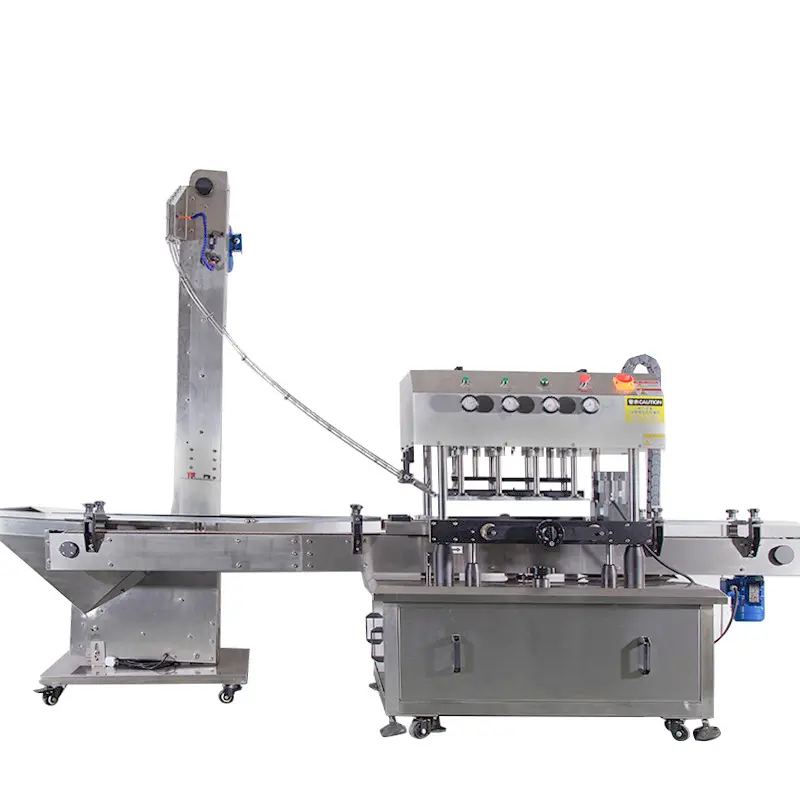
Screw-on Capping Machines
Screw-on capping machines, like screw-on spindle capping machines, rely on a vibrating bowl and cap delivery mechanism to deliver the caps to the proper container. Screw-on capping machines use a star wheel to index the bottles under the capping head, allowing them to operate at high speeds.
Once the capping sensor detects that the container is in the correct position (e.g., under the capping head), the capping head will drop down over the cap against the container. The screw-on capping machine then provides torque to ensure the container is properly sealed.
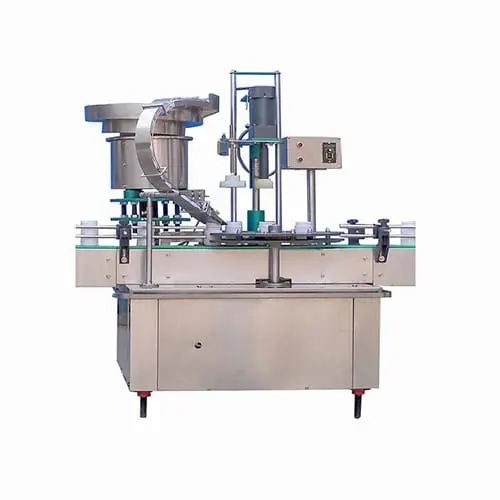
ROPP Capping Machines
Roll-on Piracy Proof (ROPP) capping machines form threads on the caps when the container is sealed. Typically, these caps are unthreaded aluminum billets that are pressed onto the container. The roll-on capping machines form around a ring on the neck of the bottle. Since they do not require the application of torque, roll-on capping machines do not require a clutch. Roll-on capping machines have many heads that provide superior sealing and tamper-proof protection. However, it is not easy to adapt these roll-on capping machines to a variety of caps. Therefore, this means that the bottles must be made of heavy-duty materials to withstand the pressure.

Press-On Capping Machines
Typically, press-on/push-on capping machines attach press caps and caps to bottles and containers at speeds of up to 105 caps per minute. Stainless steel and anodized aluminum are commonly used in the manufacture of press-on/push-on capping machines because they provide excellent corrosion protection, strength, and long-term durability. At Vtops, we specialize in manufacturing press-on/push-on capping machines with displays that provide real-time production data. These machines continuously display information such as the number of caps applied and the production rate of bottles per minute. In addition, capping information can be stored and retrieved for later use.
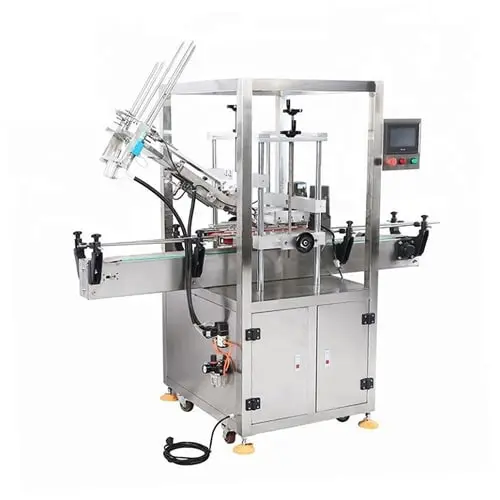
Classification by degree of automation
Automatic capping machine
At a rate of at least 200 bottles per minute, the automatic capping machine is used to sort, place and tighten the caps. However, this rate depends on whether the caps are moving continuously. Caps that rely on sporadic movements will have slightly lower output levels.
Automatic capping machines help to install caps on top of various containers faster and more accurately. This means that the machine is able to position, install and tighten the caps on a variety of containers. Beverage bottles, medicine bottles and some other containers can be automatically capped with the capping machine.
Semi-automatic capping machine
Semi-automatic capping machines are used to cap bottles with plastic screw caps, metal caps or flip caps. Semi-automatic capping machines are easy to use and highly adaptable. It can provide you with a better rate of containers per minute than manual capping machines. Typically, semi-automatic capping machines can tighten the caps at a rate of 20 containers per minute.
Semi-automatic capping machines are driven by compressed air. The advantage is that caps from various manufacturers are suitable. This machine is suitable for small and medium-sized production. Semi-automatic capping machines are suitable for flammable alcohol, ink, perfume, paint, etc.
Benchtop Capping Machine
The benchtop capping machine functions similarly to the manual capping machine, but with more torque. The benchtop capping machine has a torque range of 4 to 100 inch pounds. It relies on a cylinder activated by a foot switch to press down the cap. Typically, the cylinder pushes down on the cap, ensuring it closes properly. The benchtop capping machine ensures high torque with minimal manual effort. The machine can be used to tighten caps ranging from 10 mm to 130 mm. It makes capping a breeze. Since it can be switched without tools, all adjustments can be done manually. The machine has excellent torque accuracy and consistency. The machine can be used to tighten caps ranging from 10 mm to 130 mm. It makes capping a breeze. Since it can be switched without tools, all adjustments can be done manually. The machine has excellent torque accuracy and consistency.
Handheld/Manual Capping Machine
The manual capping machine is simple to operate, versatile, and does not require electricity to operate. In addition, the handheld capping machine is suitable for a variety of bottle caps and overcaps.
Manual capping machines are suitable for small-scale production such as laboratories. This capping machine also has international certifications for use in explosive atmospheres. Handheld capping machines are also suitable for aerosols, perfumes and small bottles with crimped edges.
The benefits of using a manual capping machine guarantee a cheap price and a high level of labor. This machine is purely pneumatic, simple to use, and its torque reproducibility depends on a steady downward pressure.
Capping machine working principle
Many capping machines use a variety of different operating principles. The working principle of a machine usually depends on the kind of machine. So this means that the nature of your tasks as an operator will depend on the type of capping machine you are running.
Typically, capping machines operate by moving the caps and bottles through a series of rotating discs or spindles. The rotational movement will be transmitted to the caps by the rotating discs. The caps will then return to their original position. There are semi-automatic spindle capping machines available.
For example, semi-capping machines
According to the capping machine with a standard base, its working principle is as follows.
First, you need to set a loose cap on the container and then place it on the base of the machine so that it rests on the backstop. The container is now correctly aligned under the capping machine and ready for capping.
The cylinder that is needed to move the capping machine up and down should be operated by a foot pedal. When the foot pedal is pressed, the cylinder drops onto the cap to be tightened, lowering the capping machine via the attached chuck.
When the chuck makes contact with the cap, it is pushed slightly upwards into the capping machine, which activates the capping motor. The capping machine tightens the bottle cap in a few milliseconds and then automatically shuts off. Its operation is similar to an impulse.
When the capping machine comes to a complete stop, you should press the foot pedal. This enables the capping motor and the attached chuck to rise from the capping machine and return to its starting position. The base of the capping machine can now be removed, revealing a perfectly sealed bottle.
Applications of Capping Machines
Our capping machines, like other packaging machines, are used in a variety of industries. A few of these industries include:
General Packaging Applications
Capping machines are used for general packaging of sensitive products. There are many industrial situations where capping machines can be used. The device is often used to provide assistance during the process of inserting and tightening the packaging cap. For example, the cosmetics industry uses various containers to keep their products safe. The delicate nature of chemical products requires the use of this equipment.
Food and Beverage Processing Applications
Ensure the safety of beverages and food products using capping machines. Almost all the beverages you drink come in cans or bottles. Also, food processing companies use containers that are easily breakable to preserve food products. Capping machines help in capping food containers during all these procedures.
These beverages need to be handled safely and are sensitive to contaminants, so they are tightly capped using capping machines.
Agricultural Applications
Capping machines are used in the agricultural industry to prevent harmful or toxic effects of substances that children and other vulnerable groups are exposed to. For example, when buying agricultural products such as pesticides and solvent fertilizers, you will notice that they are packaged in sealed containers. To ensure that the caps cannot be easily tampered with, agricultural input suppliers use capping machines.
Agricultural businesses of all sizes will purchase liquid agrochemicals from producers to increase crop yields. Herbicides and insecticides, pesticides and algaecides, and other substances can be used to control more organisms that damage field crops. For example, soil conditioners and fertilizers are agricultural chemicals that aid in plant development.
These substances can be very dangerous when they are physically handled or breathed in. When it comes to manufacturing and packaging these chemicals in variable liquid quantities and inventory quantities, capping machines are the essential answer.
Medical and Military Products
Capping machines are widely used in industries such as medical and military. Pharmaceutical companies often use a variety of packaging materials when producing and shipping medications. This is no different when it comes to military equipment. Due to their sensitive nature, these industries require very tight seals. Tamper-proof seals are created by capping machines to prevent contamination.
Most of these products can be toxic and sensitive to contamination. By using a capping machine to secure the caps tightly, they can be used safely.


